

Seemingly anyone and everyone has a take on AI transformation, but very few are doing the actual work.
Last week, we handed the mic to the operators who actually are — 75 senior enterprise tech executives together in one room for something that's been missing from the conversation: unfiltered operator truths.
No grand pronouncements, clickbait headlines, or vague predictions about AGI. Just grounded insight into what’s actually working, what’s failed, and what leaders are anticipating next, in and for their companies and, equally importantly, for themselves.
While a handful are from AI-native companies like Anthropic, most are at companies that have had to evolve to be AI-forward and a part of the AI ecosystem, including Vercel, Stripe, Databricks, Datadog, Toast, Box, Confluent, and Amplitude. These leaders have a rare vantage -- they are the ones who led and scaled their companies through previous tech transitions in SaaS/cloud and in some cases internet/mobile too. Now they are building on that experience and relearning what it takes to lead in an AI-native world.
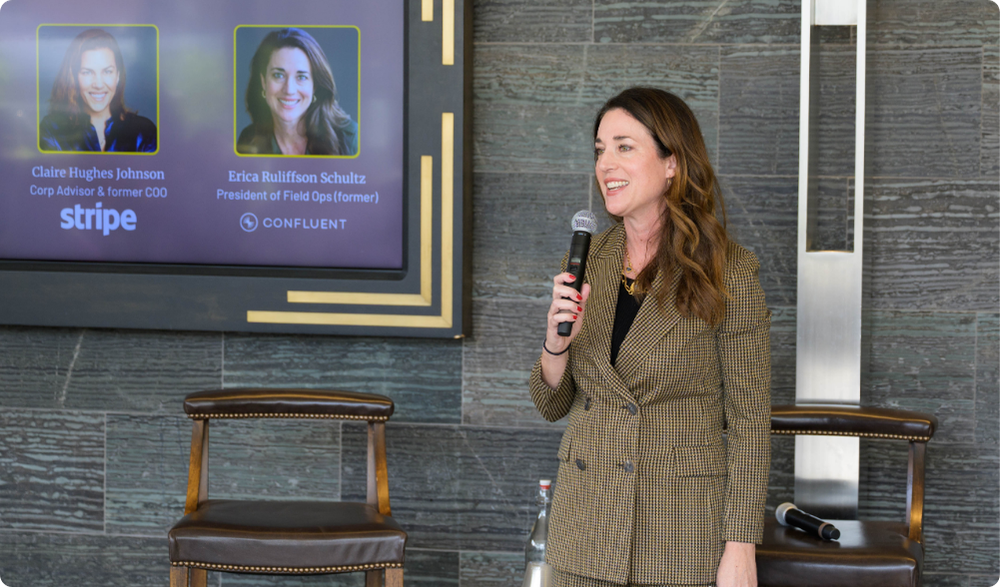
Our inaugural AI Transformation Exchange, co-hosted by legendary operators (and founding OpCo LPs and board members) Claire Hughes Johnson and Erica Ruliffson Schultz, was the culmination of what we've spent the last 7 years building at OpCo -- a close-knit group of world-class operators -- to meet this moment. Through our proprietary platform and engaged community, we maintain a real-time feedback loop with and among leaders driving AI transformation across global enterprises. This provides early visibility into budget shifts, adoption patterns, emerging categories, and more.
We anchored the event with findings from our first-ever OpCo Intelligence State of AI Transformation research report, as reported today in Axios. We surveyed 123 senior operators across go-to-market, finance, product, engineering, operations, and people functions, with a median of 22 years of operating experience. They run companies and functions at every size and stage, from early-stage startups to the largest enterprises in tech.
It's clear that the traditional playbook is a thing of the past, so here's a look at four ways enterprise AI transformation is unfolding in real time and a peek at the conversations led by our Operator LPs last week, from the perspective of those who are actually driving the change. And a big thanks to Skadden + Egon Zehnder for their help bringing the event to life!
1. Continuous Experimentation Is the New Normal
AI has moved into continuous experimentation. 77% of respondents are actively executing on AI initiatives, and 21% describe themselves as AI-native. Almost no one is in wait-and-see mode.
Elena Gomez, Toast’s President, CFO and OpCo board member, found this firsthand: "I approached it the traditional CFO way at first -- can we consolidate? Then I realized the best outcome is letting people experiment. Our bias is experimentation. We track adoption and usage. That tells us where to double down."

Maturity varies widely, though. There is no universal playbook, and the survey data showed there is no dominant accountability model for AI transformation. Small and medium companies tend toward bottom-up, informal approaches (61%), while large enterprises lean toward top-down structures with designated roles and committees (55%). About a quarter of both groups take a middle-out approach, delegating to existing functional heads. Most organizations are running dozens of parallel experiments across functions, often without centralized coordination.
As Kieran Snyder, Microsoft’s VP of AI Transformation, put it: "I was under the illusion that top-down control of AI transformation was even possible. This is an anarchist's moment, in the best way. Enablement is a much better framework for AI transformation than compliance."
The organizations moving fastest are encouraging experimentation while building just enough structure to prevent fragmentation. The real work here is redesigning the operating model itself. As Anu Bharadwaj, OpCo board member and most recently Atlassian’s President, said: “it has to be built into the day to day.”
2. AI Is Reshaping Talent Faster Than Headcount
Only 5% of leaders report significant headcount reduction driven by AI. Meanwhile, 69% report medium or high impact on talent profiles and job roles. In other words, AI is changing what people do long before it changes how many people do it.
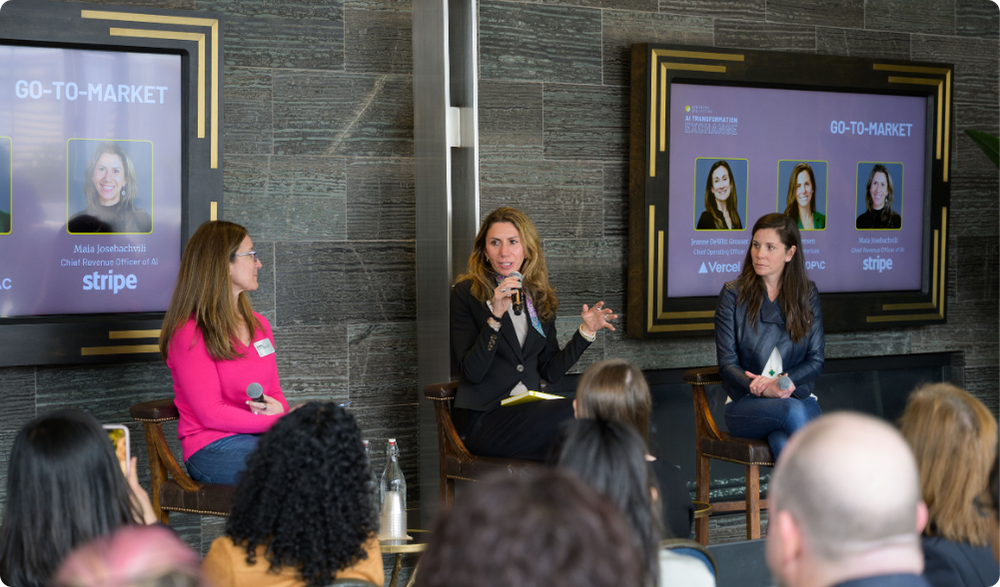
Jeanne DeWitt Grosser, Vercel’s COO, is blazing the trail and far ahead on this front: "Ten jobs to be done can now be done by a single person. We reduced roles [in GTM] to three core ones. AI handles the rest."
Nancy Wang, 1Password’s CTO and Felicis Venture Partner, described the emerging pattern: "We're seeing a barbell. Very junior AI-fluent hires on one end. Very senior architects on the other. The middle is in no man's land right now." Development cycles are compressing, team composition is shifting, and the traditional middle layer of engineering is being redefined.
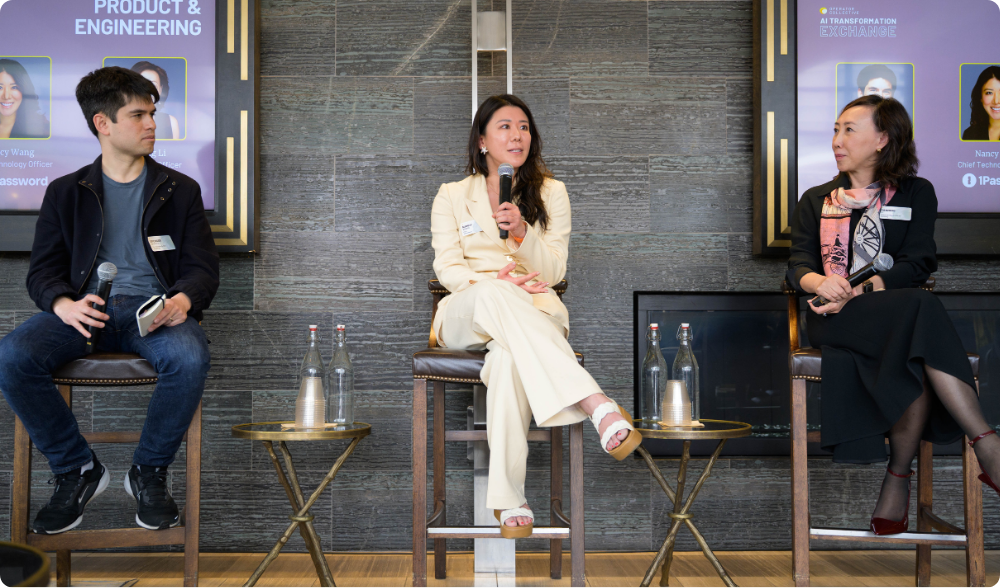
Bijal Shah, Guild’s CEO, shared a related concern: "I am deeply worried for the middle skills worker. Behavior change is probably the hardest thing in the world."
Across the conversations, and reinforced by the survey data, it's clear that AI transformation is a talent transformation. The companies pulling ahead are resetting expectations around adaptability, output, and experimentation velocity. They are hiring differently, re-leveling differently, and making hard calls about who can operate successfully in ambiguity and who cannot.
Several leaders shared privately that management turnover is already underway in their organizations. The new bar is learning speed. Spenser Skates, CEO and Co-Founder of Amplitude, has seen this in real time: "You articulate where you're going, and it becomes clear who is contributing and who is not. People self-select very quickly."
Roles themselves are beginning to blur. Box COO Olivia Nottebohm’s perspective: "You'll see product, design, and engineering blur. Solution architect, sales engineer, seller, and marketer will blur. The question is which side adapts fastest to bleed into the other."
Team compositions are actively shifting too, with agents being integrated as members of the team. Yanbing Li, CPO of Datadog: “We’re creating the micro-team: a junior engineer, a senior engineer, a product manager, supported by a group of coding agents, SRE agents and other AI tools.”
AI is compressing tasks, changing team dynamics, and collapsing traditional functional boundaries. This shift is happening quietly, and decisively.
3. Productivity Is Up? Demonstrating ROI Is Behind.
67% of respondents cited efficiency and productivity as AI's biggest benefit, yet roughly 70% report having no formal KPIs tied to those gains. The pace of work feels faster, but few can quantify how much faster at the organization level.
This comes as no surprise, especially with many AI tools starting out as point solutions that might make a particular task faster but lack the ability to integrate smoothly into existing workflows and enterprise grade systems. As Christina Liu, Sigma’s CFO, noted: "If everyone can build their own workflow on top of data, what governance ensures it's productive instead of fragmented?"
While the murkiness around quantifiable productivity gains is natural at this stage of adoption, one unlock is measurement discipline and tracking enterprise impact: defining baselines, tracking leverage, and tying AI adoption directly to operational metrics. The leaders who operationalize measurement will compound advantage faster than those relying on anecdotal acceleration.
There's also a reframing opportunity here for sales and customer relationships. There's a gap between AI ambition and the reality inside large enterprises, where buyers are still figuring out what they want AI to do. For many Fortune 500 companies, the ask often still starts with: “how we should do AI?” Deploying hands-on, customer-facing technical assistance can help ensure successful AI deployments and usage. Maia Josebachvili, Stripe’s CRO of AI, told her team this year: "Our job isn't to sell features or even products -- it's to help our customers build their growth engines."
4. The Constraint Is Organizational
When we asked what's limiting AI impact, model quality barely registered. The real constraints were organizational: tool proliferation, fragmented data infrastructure and quality, weak measurement, change resistance, and security and compliance concerns. Despite the many changes she’s made from how she’s run things pre-GenAI, Kate Earle Jensen, Head of Americas of Anthropic noted rigor still matters and some things remain constant as non-negotiables: Clean data, maintained systems, disciplined execution — these become more important, not less.
Compliance complexity is another underlying constraint. Colleen McCreary, Confluent’s Chief People Officer & Head of Internal Systems, underscored how regulatory risk is becoming intertwined with AI adoption: "Trying to use AI tools in HR and recruiting across geographies is very messy. The patchwork of regulation around AI, especially around employment, is incredibly complex. What you can do with candidates, what you can do with employees, even questions like whether you can penalize someone for not using AI -- these are legally gray areas."
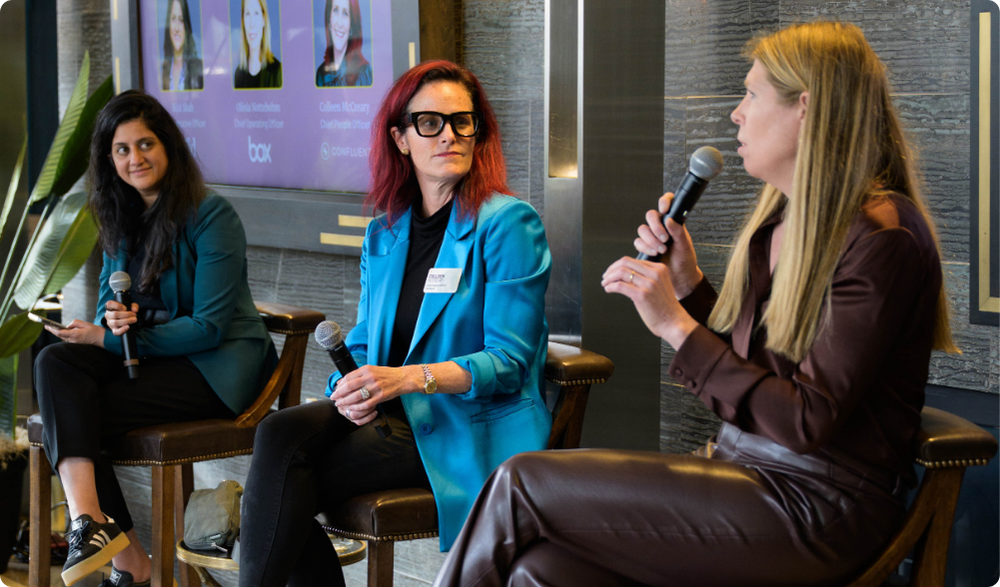
The work here spans adoption, legal and regulatory exposure, governance, and institutional risk. AI lowers the barrier to building but increases the challenges for coordination, accountability, and compliance.
For founders building AI startups, durable revenue and enterprise expansion require deep workflow integration, security credibility, and compliance readiness from day one. The model alone won't get you there. The opportunity is massive, though. Anthropic’s Kate Earle Jensen mentioned: "More than ever before, I'm seeing startups have a massive impact in enterprise from day one because tools like Claude help them build and ship at a level of sophistication that enterprise buyers actually expect, faster than was ever possible before."
A Look Inside the Tool Landscape
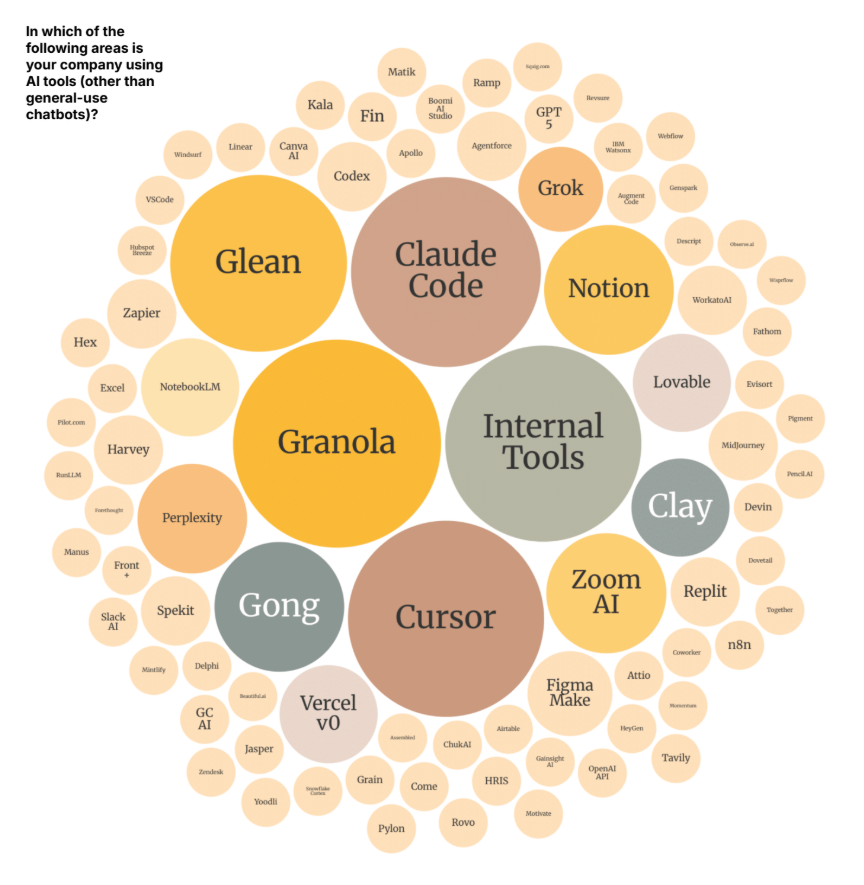
We also did a deep dive into tooling in our survey. General-purpose chatbots like ChatGPT, Gemini, and Claude have reached close to 90% adoption across both companies and individuals. Those three tools alone represent nearly half of all currently used tools cited in responses. They have become a baseline utility.
Underneath that consolidation at the top, the landscape is moving fast. 69% of tools cited were named only once, pointing to a long tail of specialized, function-specific solutions being tested across engineering, sales, legal, finance, and operations. The future tool pipeline looks very different from the current one: while current adoption is concentrated around a few dominant platforms, future consideration is spread across dozens of niche tools. Organizations are clearly looking to move beyond one-size-fits-all solutions toward tools that fit specific workflows.
Tool churn was also notable. Popular tools like Perplexity and Harvey all appeared on the churned list, showing that high adoption and name recognition doesn't guarantee retention. Specific feedback pointed to quality gaps and cost concerns. Others reported experimenting with and rejecting many tools without specifics, suggesting a healthy trial-and-error pattern but a lack of systematic tracking of what tools they've adopted, what they've dropped, and why.
What Comes Next
Claire Hughes Johnson closed the AI Transformation Exchange with a reminder that the stakes extend well beyond any single company: "There are wonderful technical advances we're all benefiting from, but deploying them at scale is still incredibly challenging. It's hill climbing. And beyond that, being involved in how the power structure is getting disrupted and recreated is important. Who is in the loop and who isn't matters. If you're not in the loop and you don't do something to change that, the outcomes will be worse than the first internet disruption."

Operator Collective is uniquely positioned at this intersection. Our 250+ Operator LPs are senior leaders who have built iconic technology companies across every function AI is reshaping. Our portfolio includes companies like Ramp, Vercel, Hex, Hightouch, Ironclad, Lovable, Clay, and ConductorOne that are building the tools these operators use and evaluate every day. Because our operators are also LPs in our fund, the insights flow both ways.
The gap between organizations figuring this out and those falling behind is widening, and it is driven by experimentation velocity, integration discipline, talent calibration, and leadership clarity.
We plan to continue the OpCo Intelligence research program and make the AI Transformation Exchange a recurring gathering. The hype is easy to find. Operational reality is harder. That is the space Operator Collective is built to lead.
If you are a senior executive navigating AI transformation, read the full State of AI Transformation Report here. If you are a founder building for the enterprise, read it carefully. This is what your buyers are wrestling with right now.
Special thanks to our portfolio CEOs - Common Room’s Linda Lian, Numos’ Parijat Sarkar, Faros AI’s Vitaly Gordon, and SurePath AI’s Casey Bleeker who presented lightning talks, Quanta’s Helen Hastings for moderating the finance exchange, our fast growing portfolio companies Hightouch and ConductorOne who co-hosted our dinner, our operators who helped us build the platform to make this possible, and of course to the incredible OpCo team, especially Anna Jacobson who spearheaded this research.

